
CBP Will Test Electronic Export Manifests for Truck Cargo Starting Oct. 23
Volunteer carriers will send advance data 24 hours before leaving the country and a full manifest two hours before reaching the port of export; CBP wants nine participants for a two-year test.
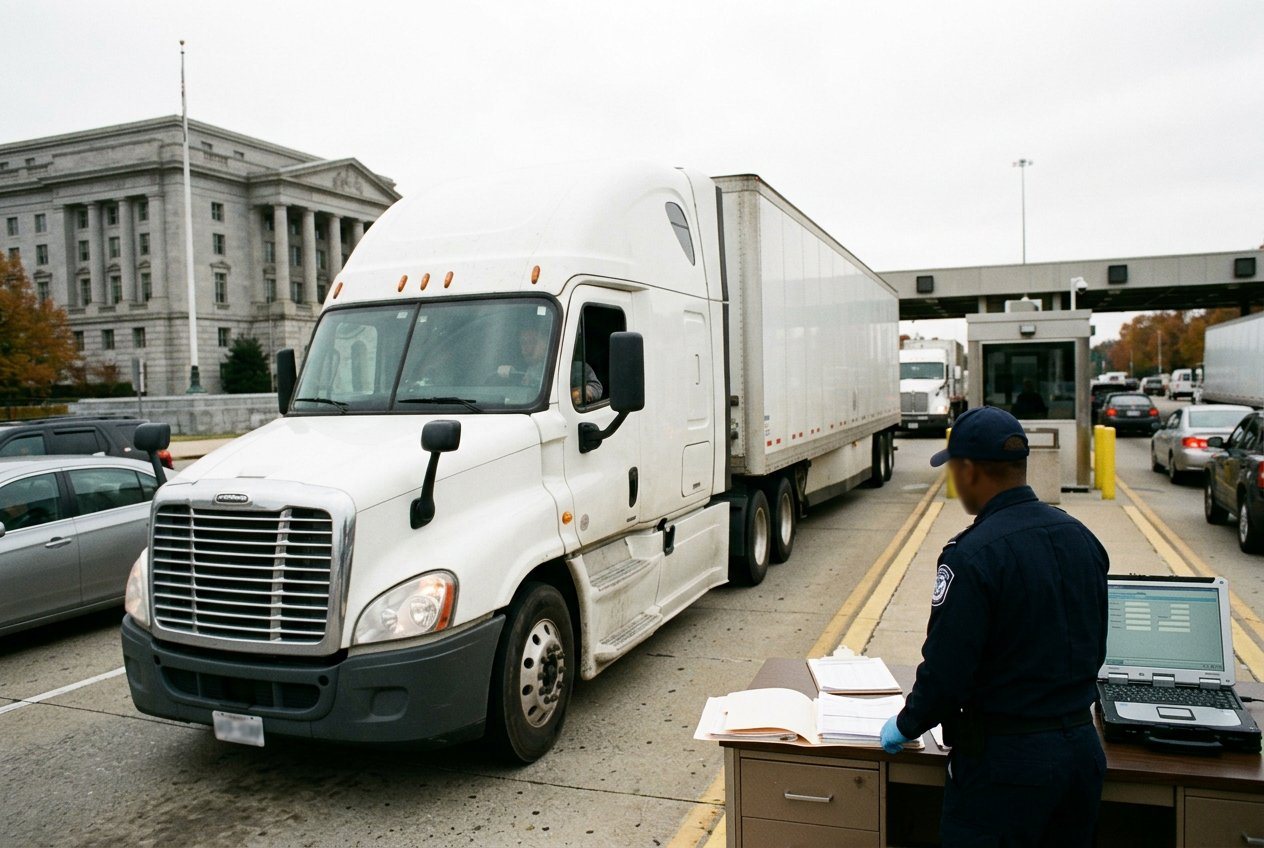
U.S. Customs and Border Protection will begin a voluntary test on Oct. 23 that requires participating truck carriers to file export manifest data electronically before their cargo leaves the United States, the agency said in a Federal Register notice published Sept. 23. The Automated Commercial Environment Electronic Export Manifest for Truck Cargo Test will run about two years, and CBP will accept applications until nine qualifying carriers have signed up.
Today truck carriers are not required to file an export manifest at all. Under 19 CFR 192.14, the U.S. principal party in interest, generally the seller or shipper, files Electronic Export Information in ACE, typically no later than one hour before the truck reaches the border, or eight hours for items on the U.S. Munitions List, and the carrier may not load the cargo until it has the filing citation or exemption legend.
Under the test, participating carriers will submit a limited set of data at least 24 hours before departure from the United States, followed by the complete export manifest no later than two hours before arrival at the final port of export. CBP said the timing will let it link the shipper's export information with the carrier's manifest data, assess risk and target shipments for inspection before loading. Cargo flagged as high-risk will be held until the carrier clarifies "non-descriptive, inaccurate, or insufficient information," a physical inspection is performed or other action is taken; a release message will go to the filer once the cargo is cleared for loading. Inspections could still occur any time before the truck departs.
The advance filing must include the bill of lading number, the cargo quantity at the lowest external packaging unit (a container holding 10 pallets with 200 cartons is described as 200 cartons), total weight, a precise cargo description with the six-digit Harmonized Tariff Schedule number when the shipper provides it (generic descriptions such as "FAK" or "general cargo" are not acceptable), and the complete names and addresses of the shipper and the consignee, among seven required elements.
The notice says the test's purpose is to evaluate "the feasibility of requiring truck carriers to file export manifest data" and to advance the single-window International Trade Data System required by the SAFE Port Act. CBP is conducting it under the Customs Modernization Act, 19 U.S.C. 1411-1415, and 19 CFR 101.9(b), which allow the agency to impose requirements different from its regulations for a test. Comments may be submitted at any time during the test.
What it means
For carriers hauling to Mexico and Canada, this is the first step toward a manifest obligation that has applied to ocean, air and rail for years but never to trucks. A 24-hour advance data requirement would change dispatch and loading practice for cross-border freight, since the carrier would need shipment details well before the truck is loaded. The nine test slots give carriers a chance to shape how that requirement works before any rulemaking.
What's next
The test starts Oct. 23, 2026, and CBP will announce any extension, change or early end in the Federal Register. Carriers interested in participating apply by email as described in the notice; comments on any aspect of the test are open throughout.
Sources
Notice: Electronic Export Manifest for Truck Cargo Test — Federal Register (U.S. Customs and Border Protection), 2026-09-23
Related coverage
CBP pilot to test electronic truck export manifests — Transport Topics, 2026-09-29