
NHTSA Finalizes Lower CAFE Fuel-Economy Targets for 2022-2031 Vehicles
The agency's final rule drops electric-vehicle fuel economy and credit trading from how it sets mileage standards for passenger cars and light trucks, reversing approaches used in 2020, 2022 and 2024 rules.
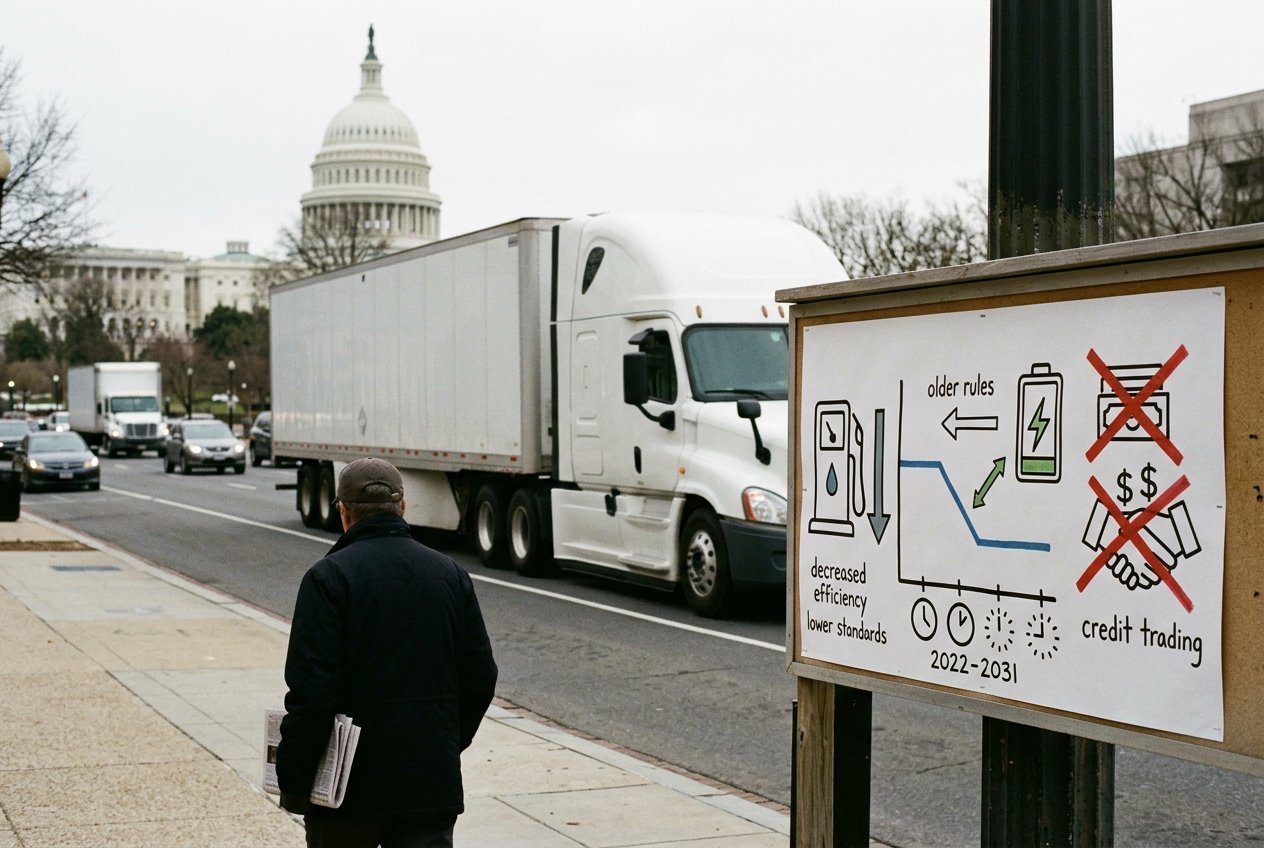
The National Highway Traffic Safety Administration (NHTSA) has finalized new Corporate Average Fuel Economy (CAFE) standards for model years 2022 through 2031, covering passenger cars and light trucks, according to a final rule filed for public inspection on Sept. 29, 2026, and scheduled for publication in the Federal Register on Sept. 30, 2026. The rule carries docket number NHTSA-2025-0491 and regulation identifier number 2127-AM76.
The rule, titled the Safer Affordable Fuel-Efficient (SAFE) Vehicles Rule III, applies to companies that manufacture, import or convert new passenger automobiles and light trucks, NHTSA said. It does not cover medium- or heavy-duty trucks regulated separately under other federal programs.
NHTSA said it is setting passenger car standards that increase 0.90 percent per year through model year 2029, then 1 percent per year through 2031, with 2030 serving as a transition year tied to a reclassification of vehicle categories. Light truck standards increase 0.51 percent per year through 2029, then 1 percent per year through 2031, the agency said.
The agency estimated the final standards correspond to a projected combined industry fleet average of about 34.9 miles per gallon in model year 2031, though NHTSA cautioned that actual fleet averages depend on the mix of vehicles manufacturers build and sell.
A central change, according to the rule, is that NHTSA no longer considers the fuel-economy performance of electric vehicles or the electric-only operation of plug-in hybrids when calculating standards, a shift from the approach used in the 2020, 2022 and 2024 rules. NHTSA said those earlier standards "failed to satisfy substantive statutory requirements" because they factored in EV fuel economy and compliance credits, which the agency said are not permitted considerations under the Energy Policy and Conservation Act as amended.
The rule also eliminates the inter-manufacturer credit trading program beginning with credits earned in model year 2028. Credits earned through model year 2027 may still be bought, sold and applied for up to five years after they were generated, NHTSA said. Separately, the agency is removing air-conditioning efficiency and off-cycle technology adjustments from its standard-setting analysis starting with model year 2028.
NHTSA is also finalizing changes to how vehicles are classified as passenger cars versus light trucks, tightening criteria tied to off-highway capability and cargo or towing function, effective with the model year 2030 standards. The agency said many vehicles currently classified as light trucks, including many all-wheel-drive crossovers, do not meet true off-highway or cargo-hauling functions.
The Department of Energy reviewed a prepublication copy of the rule under 49 U.S.C. 32902(j) and said in an Aug. 8, 2026, memorandum that it was satisfied the new standards would not adversely affect the department's conservation goals.
NHTSA estimated the rule will reduce average up-front vehicle costs attributable to CAFE compliance by about $1,290 compared with a baseline scenario without the changes, and said the rule is net beneficial for society under its regulatory impact analysis.
What it means
The rule applies to light-duty vehicles — passenger cars, pickups, SUVs and vans — not the heavy trucks and buses that most FMCSA-regulated carriers operate. But fleets that run light-duty support vehicles, parcel vans or last-mile delivery trucks should watch how manufacturers respond to the reclassification criteria, which could change vehicle specifications, pricing and availability in coming model years. Brokers and shippers relying on light-truck capacity may see shifts in vehicle design as automakers adjust to the new passenger car/light truck boundaries.
What's next
The rule is effective 60 days after its Federal Register publication; based on the Sept. 30, 2026, scheduled publication date, that places the effective date around late November 2026, though NHTSA's filed text uses placeholder language pending the official Federal Register date. Vehicle reclassification standards take effect with model year 2030. The end of inter-manufacturer credit trading applies to credits earned starting in model year 2028, with legacy credits usable through model year 2032.
Sources
Rule (public inspection): Safer Affordable Fuel-Efficient Vehicles Rule III for Model Years 2022 to 2031 Passenger Cars and Light Trucks — Federal Register public inspection (National Highway Traffic Safety Administration), 2026-09-30
Other: CAFE Final Regulatory Impact Analysis and Technical Support Document — Regulations.gov (NHTSA), 2026-09-28
Other: Docket Memorandums — Regulations.gov (NHTSA), 2026-09-28